How Long Should You Plan for an Indoor Playground Visit?
Is one, two or three hours enough at an indoor playground? Our guide explains how long to plan by age, playground size, naps and ticket type.
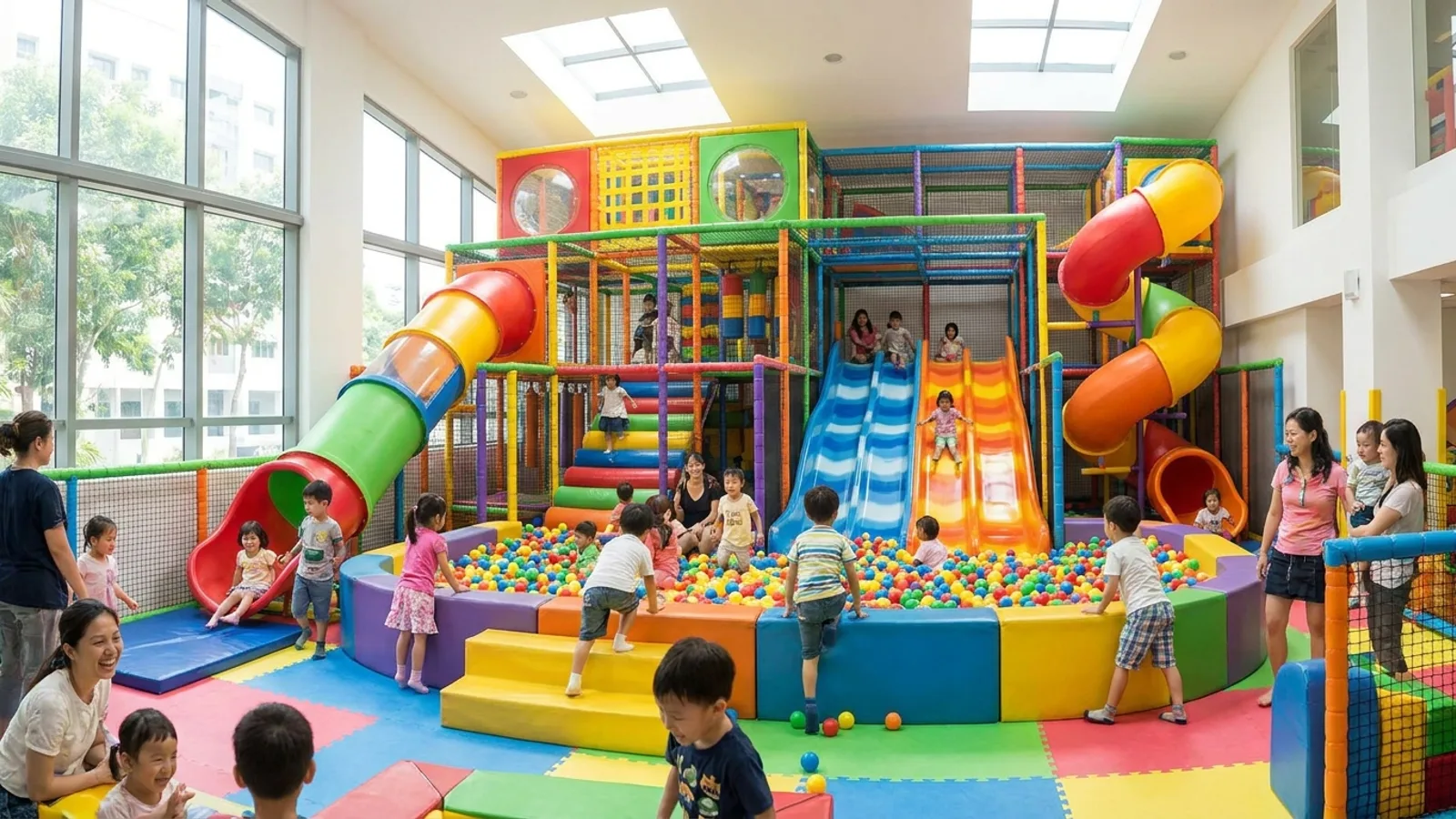
For most indoor playgrounds in Singapore, around 1.5 to 2 hours of actual play is a good starting point. That is usually enough time for a child to settle in, explore properly, go back to the things they liked most and leave before hunger or tiredness starts undoing the good mood.
That does not mean every family should automatically buy a two-hour ticket. A toddler may be perfectly happy after 60 minutes at a compact soft-play space, while a primary-school child can easily spend three hours somewhere with climbing, high elements or several distinct activity zones. The size of the playground matters, but so do your child’s age, how quickly they warm up to a new space and whether you are visiting for the first time.
It is also worth separating play time from outing time. A two-hour admission rarely means you will be in and out of the venue in exactly two hours. Once you add check-in, grip socks, toilet breaks, changing, snacks and the surprisingly lengthy process of convincing a child that the final slide really was the final slide, the whole outing can take closer to three hours.
How much time should you allow at an indoor playground?
As a rough guide, this is what we would plan:
| Child or playground type | Play time to plan | Total outing time |
|---|---|---|
| Baby or young toddler | 45–90 min | 1–2 hours |
| Toddler aged 2–3 | 1–1.5 hours | 1.5–2 hours |
| Preschooler aged 3–6 | 1.5–2 hours | 2–2.5 hours |
| Primary-school child | 2–3 hours | 2.5–3.5 hours |
| Small mall playground | 45–90 min | 1–1.5 hours |
| Medium soft-play playground | 1.5–2 hours | 2–2.5 hours |
| Large destination playground | 2–3 hours | Around 3 hours or more |
| Unlimited-play venue | 2–4 hours with breaks | Potentially half a day |
These are planning estimates rather than targets. Some children will spend 40 minutes repeating the same slide and announce they are finished; others will still be negotiating for another round three hours later.
For most families, two hours is the easiest place to start
Two hours works well because it gives children enough time to move beyond the initial excitement and actually use the playground properly, without turning the outing into an endurance event.
This is especially true for preschoolers. A three- or four-year-old may spend the first 15 minutes cautiously inspecting a climbing structure, then suddenly discover the ball pit, move on to pretend play, return to the climbing frame and spend the final half-hour doing exactly the same slide repeatedly. With only an hour, the visit can feel as though it is ending just when they have settled in.
That is also why so many commercial indoor playgrounds in Singapore structure their tickets around timed sessions. At a venue such as Pororo Park Singapore, where younger children can move between climbing, sensory play, a ball pit, train rides and character-themed areas, there is enough variety for a toddler or preschooler to spend a couple of hours without needing the intensity of a huge adventure playground.
If you have never visited a venue before and the price difference between one and two hours is reasonable, we would usually choose two.
Is one hour enough at an indoor playground?
It can be — and for some children, one hour is actually the better choice.
Compact indoor playgrounds are often most useful when they fit into the rest of the day rather than becoming the whole day. If you are squeezing in some play before lunch, waiting for an older sibling to finish a class or simply trying to burn off energy before heading home, an hour may be plenty.
Toddlers are also surprisingly efficient at exhausting themselves. A ball pit, small slide and pretend-play corner can occupy an 18-month-old very happily for 45 minutes, after which another hour may add very little except tiredness.
One-hour tickets tend to work best when the child is under three, the playground is small, you have visited before or you are combining play with something else in the same mall. For example, our guide to playgrounds near Tampines MRT includes both quick free play stops and paid indoor options such as Jolly Jungle, making it easier to choose something proportionate to the amount of time you actually have.
Where one hour feels much tighter is at a large or unfamiliar venue. First visits naturally involve more wandering around, and children often need a little time before deciding what they like. By the time they finally discover their favourite part, your session may already be nearly over.
How long should you plan for a toddler?
For most toddlers, 60 to 90 minutes of active indoor play is a very reasonable outing.
It is easy to assume that more playtime is always better because you have paid for admission, but toddlers do not think in cost-per-hour. Indoor playgrounds are stimulating places: other children are moving around them, music may be playing, lights are flashing, and there are new surfaces and obstacles everywhere. A child can be having a wonderful time and still become completely overwhelmed ten minutes later.
With a child under three, we would rather leave when they are still enjoying themselves than wait until they are exhausted enough to make leaving difficult.
For a very small playroom, 45 minutes may be enough. At a medium-sized playground, an hour to 90 minutes often feels about right. A confident two- or three-year-old can certainly play for two hours, particularly if the venue mixes physical play with quieter activities such as pretend play or sensory areas.
Real children do not always follow those estimates, of course. One parent who reviewed Tayo Station on Singapore Playgrounds brought her 22-month-old toddler and ended up staying for around three hours because the driving circuit, slides, ball pit and trampoline held her attention. That is a useful reminder that temperament and interests can matter more than the number on a birthday cake.
Preschoolers often get the most out of a two-hour session
Between about three and six, indoor playground visits become considerably easier to stretch.
Preschoolers can usually climb more independently, follow longer pretend-play scenarios and return to favourite areas without needing an adult to facilitate every activity. They are also more likely to move between different kinds of play, which is why a venue with both active and imaginative areas can hold their attention for longer than a simple climbing frame.
For this age group, 1.5 to 2 hours is the range we would plan most often. A one-hour visit can still work at a compact playground, but it is more likely to feel rushed. Three hours can be worthwhile at a larger destination, although we would not automatically pay for the extra hour unless we already knew the child had the stamina for it.
If your child prefers calmer spaces, it is also worth looking beyond the biggest indoor playground brands. Our guide to underrated indoor playgrounds that are usually less crowded includes smaller venues where children may spend their time very differently — more role play and open-ended exploration, and less racing between giant slides.
Older children need more challenge, not necessarily more time
Once children reach primary-school age, the question becomes less about how large the playground is and more about what there actually is for them to do.
A seven-year-old may finish exploring a toddler-oriented soft-play centre in less than an hour, but the same child could spend three hours somewhere with obstacle courses, climbing walls, trampolines or high elements. At this age, a bigger floor area does not automatically translate into a longer visit; the equipment needs to offer enough challenge to make repeating it interesting.
That is why we would look closely at the age range and activity mix before buying the longest ticket. A venue such as Kiztopia Club Punggol, for example, combines duplex play and role-play areas and is designed for a broader spread of toddlers, preschoolers and primary-school children. For an older child, the parts of the playground they can actually engage with matter more than the headline square footage.
For most primary-school children, two hours is still a sensible starting point, stretching to three at a genuinely large or activity-heavy venue.
A two-hour ticket can easily become a three-hour outing
You might have a two-hour session, but there is often a queue to check in, a waiver to deal with, shoes to remove and grip socks to locate. Halfway through, someone will need the toilet. After the session, children need to wash their hands, change if they are sweaty and somehow be persuaded to leave.
A fairly normal outing might look like this:
| Part of the visit | Rough time |
|---|---|
| Arrival and check-in | 10–20 min |
| Shoes, socks, locker and toilet | 5–10 min |
| Actual play | 1.5–2 hours |
| Water / toilet breaks | 10–20 min |
| Packing up and changing | 10–15 min |
| Snack or meal afterwards | 30–60 min |
That is why we would not book another timed activity for exactly two hours after your playground entry slot. Give yourself at least another 30 to 60 minutes, particularly if you are travelling by MRT with a young child.
Should you buy a two-hour or three-hour ticket?
If you are deciding blind, we would buy two hours first.
Three hours becomes more attractive when the playground is large, the child is around five or older, you have visited before and already know they like it, or there is enough variety to switch between energetic and quieter play. It also makes more sense if the venue allows children to take a useful break and return to the play area.
What we would not do is buy three hours simply because the price per hour looks better. Indoor playground tickets encourage a strange kind of parental accounting where staying longer begins to feel like getting your money’s worth. But a third hour during which a tired child is arguing over toys is not better value than leaving after two good ones.
The better question is whether your child is likely to use the extra hour.
Unlimited play is useful because you can stop watching the clock
Unlimited-play venues change the calculation slightly. The benefit is not necessarily that your child can play for six hours. It is that you can slow the day down. Families with siblings of different ages may appreciate being able to take a break, have something to eat and decide whether everyone still wants to continue rather than squeezing everything into a fixed countdown.
We would generally allow two to four hours for an unlimited-play outing, with breaks where possible. Younger children may still be completely satisfied after two.
Unlimited play is particularly useful on days when the weather has ruined other plans, or when you have made a longer journey and do not want a rigid session to dictate the afternoon.
Small mall playgrounds are better treated as part of the day
Not every indoor playground needs to be a destination. A compact mall soft-play centre may work best for an hour before lunch, particularly with toddlers and preschoolers. You get the air-conditioning, toilets and food nearby without having to construct the whole day around a playground ticket.
That is also why free indoor playgrounds can be so useful. They do not create the same urge to maximise every minute. A child can play for 25 minutes while you are already at the mall, then move on when they have had enough.
For these smaller venues, we would usually allow 45 to 90 minutes, rather than assuming the longer ticket is better simply because it exists.
When should you schedule the visit around meals?
We prefer children to arrive neither very hungry nor completely full.
For a morning playground session, breakfast followed by play and then lunch tends to work particularly well. A preschooler might eat around 9am, start playing at 10am and finish close to noon, which gives the outing a natural endpoint.
Afternoons can work in much the same way: a snack first, play from around 3pm to 5pm, then dinner.
Trying to stretch an indoor playground session across a normal mealtime often creates more trouble than the extra play is worth. A child who has started asking repeatedly for food is unlikely to rediscover their enthusiasm simply because another 45 minutes remains on the ticket.
Nap time matters more than ticket value
If your child normally naps at 1pm, buying a noon-to-3pm session because it gives you an extra hour is unlikely to improve the outing. Even if they happily play through their usual nap, you may spend the rest of the afternoon dealing with the consequences.
Where possible, we would finish active play 30 to 60 minutes before the usual nap window. That gives you enough time for a toilet stop, lunch and the journey home without having to rush.
For children who still nap, a good playground session often looks shorter on paper but works much better in practice.
Is morning or afternoon better for an indoor playground?
For toddlers and preschoolers, morning is generally our first choice, especially on weekdays. Children tend to be fresher, many commercial venues are calmer soon after opening, and the outing can end naturally around lunch or nap.
If your schedule is flexible, weekday mornings can also be noticeably more relaxed than school holidays or weekends. We cover the same principle across both indoor and outdoor venues in our guide to the best times to visit popular Singapore playgrounds.
Afternoons work well for older children, particularly after school, but there is a greater chance of running into the after-school crowd. On weekends, going close to opening time is often worth the earlier start.
What if you are bringing two children?
Two children do not necessarily mean you need a longer ticket, but they do mean you should leave more breathing room around the booking.
Siblings rarely want to do the same thing for the same amount of time. One may decide the ball pit is all they need while the other wants to work through every climbing route. If there is a large age gap, they may gravitate towards completely different parts of the playground.
A two-hour session can still be perfectly adequate, but we would avoid scheduling anything important immediately afterwards. That gives each child enough time in the area they prefer without constantly moving one sibling along to follow the other.
It also helps to choose a playground that genuinely covers both ages rather than simply admitting both ages.
How do you know when it is time to leave?
The ticket tells you when you have to leave. Your child usually tells you when you should.
For younger children, we would start wrapping things up once small frustrations are repeatedly becoming major ones, coordination is getting noticeably sloppier or they are spending more time wandering than playing. Sudden fights over equipment that nobody cared about 20 minutes earlier are another reliable sign.
You do not have to wait for overtiredness to prove that you received the full value of the ticket.
Some of the easiest indoor playground trips are the ones where everyone leaves thinking they could happily have stayed another ten minutes.
Our rule of thumb by age
If you have never been to the playground before, this is the range we would start with:
Under two: around 45–75 minutes can be plenty, particularly at a small venue.
Two to three years: plan roughly 60–90 minutes, extending towards two hours for confident toddlers who enjoy active play.
Three to five years: 1.5–2 hours usually gives enough time to explore without rushing.
Five to eight years: around two hours is a good default, with three hours making more sense at larger or more challenging venues.
Eight and above: choose based on the actual activities rather than the words “indoor playground”. Older children are more likely to stay longer because something is challenging than because there is simply more equipment.
Once you know how your own child responds, that experience is more useful than any general recommendation.
Frequently asked questions
Is one hour enough for an indoor playground?
Yes, particularly for toddlers, repeat visits and compact indoor playgrounds. At a larger venue, however, an hour can feel quite rushed once you include getting settled and any toilet or water breaks.
Is two hours enough for an indoor playground?
For most families, two hours is the safest starting point. It tends to work particularly well for preschoolers and younger primary-school children because there is enough time to explore properly without committing the family to half a day.
Is three hours too long?
Not necessarily. Three hours can work very well for older children at larger playgrounds, especially if there are several different activity zones or somewhere to take a break. For a toddler, three continuous hours is more likely to be unnecessary, although individual children can certainly surprise you.
How much extra time should I allow around a two-hour booking?
We would leave at least 30 to 60 minutes of buffer, and longer if you intend to eat afterwards. A two-hour play session often occupies closer to three hours once you include check-in, toilets, changing and actually leaving the venue.
Should I pay to extend the session?
Only if the child is still genuinely playing and enjoying themselves. If they are already hungry, tired or losing interest, another half-hour rarely improves the outing simply because it is inexpensive.
How long should a toddler spend at an indoor playground?
Around one to 1.5 hours is a good starting point. Very young toddlers may be satisfied with less, while active two- and three-year-olds can comfortably stretch towards two hours at the right venue.
What if my child can play for much longer?
Then let your own experience override the averages. Some children genuinely have the stamina and interest for three-hour visits. Our parent review of Tayo Station is a good example: a 22-month-old stayed for about three hours because the vehicle-themed play happened to line up perfectly with what she loved.
So, how long should you actually book?
If you have never visited the playground before, two hours is usually the safest choice.
Scale down to an hour for a young toddler, compact play space or quick mall stop. Stretch towards three hours when you have an older child, a genuinely large playground or previous evidence that your child will actually use the time.
More importantly, do not plan the rest of the day as though a two-hour booking takes only two hours. Once check-in, toilet trips, changing and the exit negotiations are included, you may easily spend three hours around the venue.