Which Singapore Indoor Playgrounds Are Actually Worth the Admission Price?
Which indoor playgrounds in Singapore are actually worth paying for? We compare 2026 prices at Tayo Station, Kiztopia, Pororo Park, Giggle Jungle, DreamDora and more.
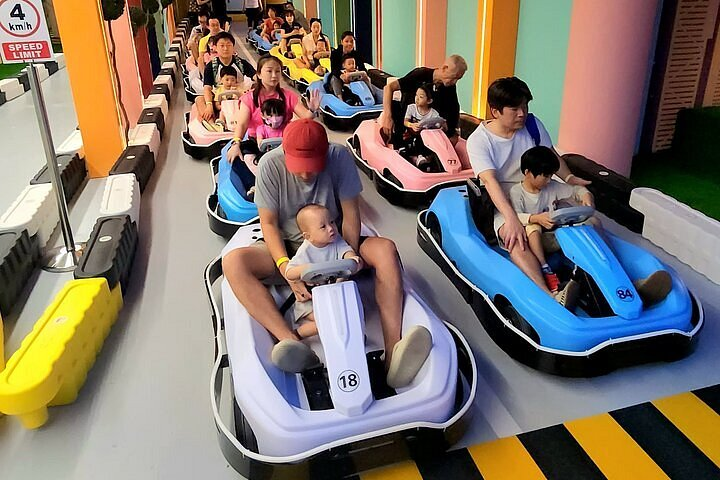
Research, experience and checks
We separate first-hand experience, source-based research and commercial relationships so you can see what each recommendation is based on.
Prices and standard admission structures were checked against official venue and operator information available on 28 October 2026 wherever possible. We compared standard public admission rather than ranking playgrounds primarily on short-term promotions. Value judgements consider session length, age fit and how much of the venue a child is realistically likely to use.
SingaporePlaygrounds has personally visited some of these playgrounds. Other recommendations in this version are based on current operator information, SingaporePlaygrounds directory research and published venue features unless an individual listing states that it has been personally visited.
Tayo Station, Giggle Jungle by Yooland, DreamDora, Kiztopia, Pororo Park Singapore, HomeTeamNS, VroomTown and Science Centre Singapore.
2026-10-28
SingaporePlaygrounds.com has not ranked these venues according to affiliate commission, paid placement or operator advertising. Any future commercial relationship should be disclosed on the relevant listing without changing the editorial verdict.
Indoor playgrounds in Singapore are no longer especially cheap outings. Once admission creeps towards S$35 or S$40 for one child, it becomes reasonable to ask whether the experience is actually worth paying for, especially when grip socks, parking, meals and an extra adult can push the total much higher.
The answer depends much more on the child than the ticket price.
A large playground can feel like excellent value if your child spends two hours moving happily between climbing structures, slides and role-play zones. A cheaper one can still feel expensive if they lose interest after 45 minutes. Age matters too. A sprawling playground built around tall slides and obstacle courses may be completely wasted on an 18-month-old, while a smaller character-themed space can be exactly right for a three-year-old who wants to ride the same train five times.
For this guide, we looked at current public admission prices, typical session length, how much variety there is once you are inside, and which ages are most likely to make proper use of the space. Prices were checked against operator information available on 28 October 2026.
The short version
For younger children, Tayo Station is one of the easier tickets to justify. It is cheaper than many of the big-name indoor playgrounds and has a proper road circuit, which gives it more staying power for toddlers and preschoolers who love vehicles.
Giggle Jungle is a stronger pick for mixed-age siblings because the S$35 two-hour ticket covers everything from toddler play to climbing walls and high ropes for children who meet the requirements.
DreamDora sits somewhere in between. It is not enormous, but the Pet Hospital, sensory play and indoor Ferris wheel give children more to do than simply climb and slide.
Kiztopia Marina Square costs more, but at least the premium is visible once you are inside. It is large enough for an active preschooler or younger primary-school child to spend a full session exploring different zones.
Pororo Park is much more dependent on the child. It can absolutely be worth S$38 for a Pororo-loving toddler. For an older child who does not care about the characters, the value is far harder to defend.
And if you are a Singapore Citizen or PR, KidsSTOP is difficult to beat on price. It is not a conventional soft-play centre, but as an indoor play outing it offers a huge amount for relatively little.
Indoor playground prices compared
| Venue | Typical admission | Best fit | Value take |
|---|---|---|---|
| Tayo Station | S$27.90 weekday / S$31.90 peak for 2 hours | Toddlers and preschoolers | Very good |
| Giggle Jungle | S$35 for 2 hours | Mixed-age siblings and active children | Very good |
| DreamDora | S$36 for 2 hours | Ages roughly 3–8, especially pretend-play fans | Good |
| Pororo Park | S$38 for 2 hours | Younger Pororo fans | Good for the right child |
| Kiztopia Marina Square | S$39.80 for 2 hours | Active preschool and younger primary | Good if they use the full venue |
| VroomTown | S$49 first visit / S$38 returning driver for 1 hour | Vehicle-obsessed children | Better judged as an attraction |
| KidsSTOP | SG/PR: S$5 child + S$2 adult off-peak | Ages 18 months–8 | Excellent |
Prices can change, especially during school holidays and promotional periods, so it is worth checking again before you go.
Tayo Station: one of the better-value choices for younger children
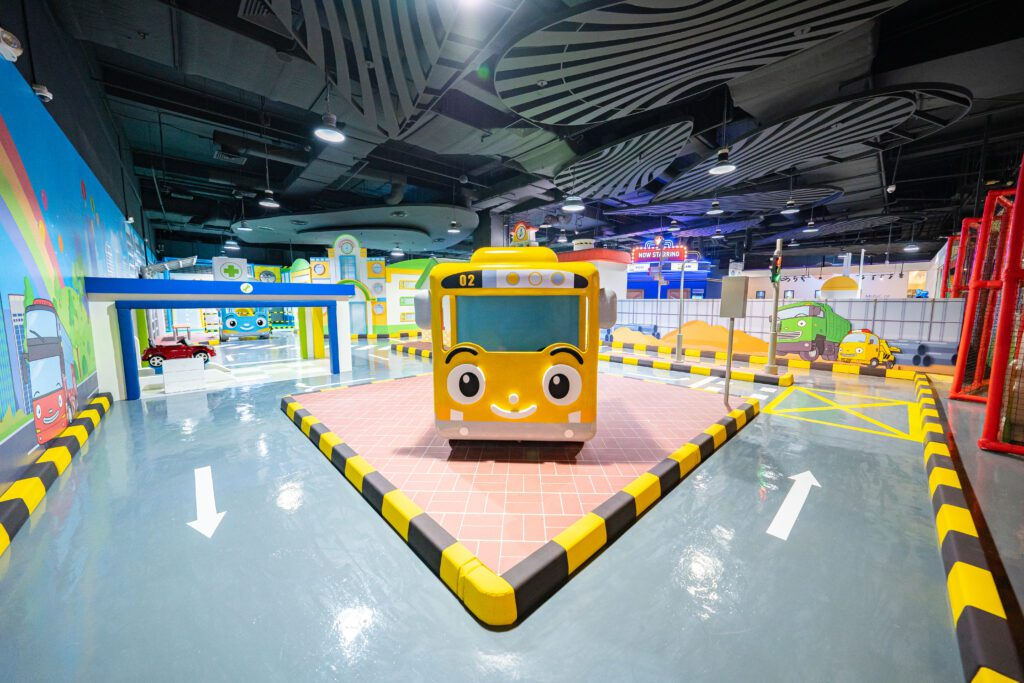
Tayo Station works because the theme is not just decoration. The road circuit is the main draw. Children can get into ride-on vehicles and move around a miniature road system with lane markings and road-safety features, then switch to the three-storey play structure, slides, ball play and Hinoki sensory area when they have had enough of driving.
Current admission is S$27.90 for two hours off-peak and S$31.90 during peak periods, with one child and one adult included. The three-hour ticket is only a little more.
That makes Tayo unusually easy to recommend for children around two to six. It is not the biggest indoor playground in Singapore, but that is not necessarily a disadvantage with younger children. The equipment is manageable, the road circuit gives the venue a clear identity, and most preschoolers can make good use of a two-hour session without feeling overwhelmed.
Where it becomes less convincing is with older primary-school children. If they want big slides, climbing challenges or something physically demanding, the gentler Tayo setup may feel too young.
For the right age group, though, this is one of the better balances of price and actual play time.
Giggle Jungle: good value when siblings are different ages
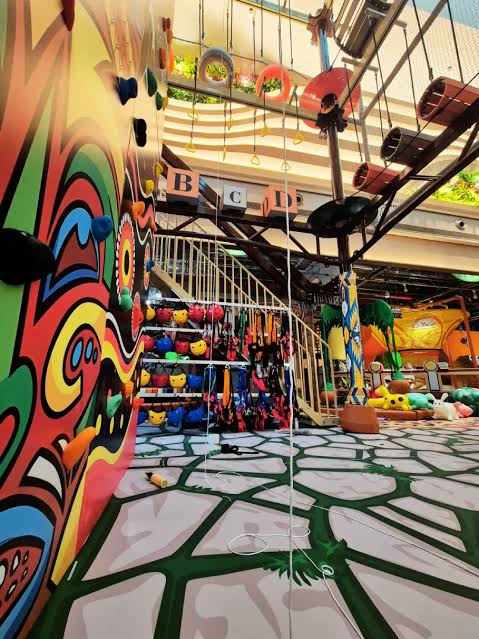
Giggle Jungle by Yooland at City Square Mall charges S$30 for one hour, S$35 for two hours and S$45 for unlimited play.
The two-hour ticket is the obvious one. Another S$5 doubles the session, which makes the one-hour option difficult to justify unless you genuinely only have a short window.
What makes Giggle Jungle worth looking at is the age spread. There is a toddler area, ball play, slides, sensory play and trampolines, but older children are not stuck circling the same soft-play structure. Those who meet the age and height requirements can move on to the climbing wall and high ropes.
That is particularly useful for families with siblings several years apart. Many indoor playgrounds are wonderful for preschoolers and noticeably less interesting once children get older. Giggle Jungle stretches further.
SingaporePlaygrounds visited the venue in October 2026, and that mixed-age range is probably its strongest selling point.
The obvious caveat is that younger children cannot use some of the features that make the venue distinctive. If your child is too small for the climbing wall and high ropes, S$35 starts to look less compelling.
DreamDora: not huge, but the play is varied enough
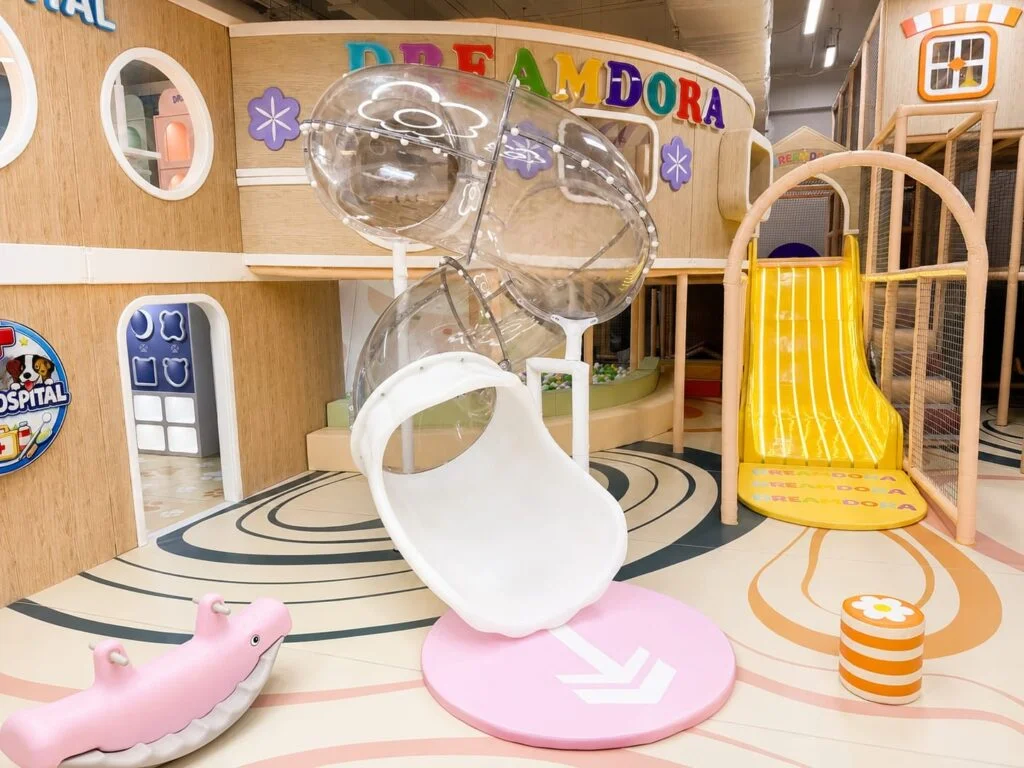
DreamDora at Dunearn Village charges S$28 for one hour and S$36 for two hours, with one child and one adult included.
Again, the two-hour ticket makes far more sense. The extra S$8 buys another full hour.
DreamDora is smaller than some of the flagship indoor playgrounds, but it uses the space quite well. The two-storey Pet Hospital gives children a proper role-play area, while the sensory zone and indoor Ferris wheel break up the usual rhythm of climb-slide-repeat. That matters more than sheer size for some children.
A child who enjoys pretending to be a vet can spend a surprisingly long time in one part of the playground, then move back into the more active areas when they are ready. For preschoolers and younger primary-school children, that makes the S$36 ticket reasonably easy to justify.
If your child mainly wants towering climbing structures or fast slides, however, there are larger venues at a similar price.
Kiztopia Marina Square: expensive, but at least it feels substantial
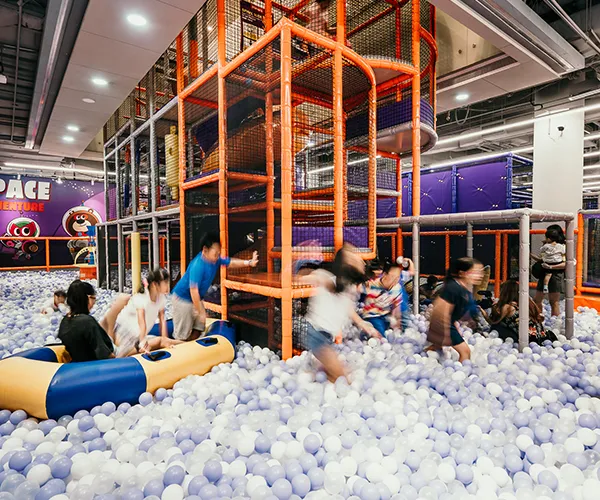
Kiztopia Marina Square currently charges S$39.80 for two hours and S$49.80 for three hours. That is firmly in expensive-outing territory. Once you add food, transport and perhaps another adult, a simple playground trip can quickly become a S$60–S$80 afternoon.
The reason Kiztopia still makes this list is that the venue is large enough for many children to use the time properly. At around 18,000 square feet with numerous play zones, there is more chance of a preschooler or younger primary-school child finding several things they want to return to rather than exhausting the space quickly. That is where price alone can be misleading.
A S$40 playground that keeps a child occupied for two full hours may offer better value than a S$30 venue they are ready to leave after 50 minutes.
Kiztopia becomes less attractive for younger toddlers who are only going to use one or two small sections. Paying flagship-playground prices for a child who spends the entire session in one ball pit is harder to defend.
It is also worth noting that the Marina Square flagship is due to close on 28 March 2027 as part of the mall’s redevelopment, so check expiry terms carefully before buying longer-term passes tied specifically to this outlet.
Pororo Park: the value is partly in the character experience

Pororo Park Singapore is a good example of why comparing playgrounds by square footage does not tell you very much.
Current admission is around S$38 for two hours or S$45 for three hours.
If you compare the physical play equipment alone, that looks expensive. For a little more money, other venues give older children bigger climbing structures and more demanding play. But Pororo Park is not really selling only the equipment. The Pororo Express train, themed environments and character elements are a significant part of the experience.
For a three-year-old who already loves Pororo, those things can carry an entire visit. However, for an eight-year-old who does not care about the characters, the same S$38 feels much less compelling.
That is why we would not call Pororo Park universally good or bad value. It is very good value for the right younger child, and noticeably weaker value once the character appeal disappears.
T-Play: often better value than the bigger brands
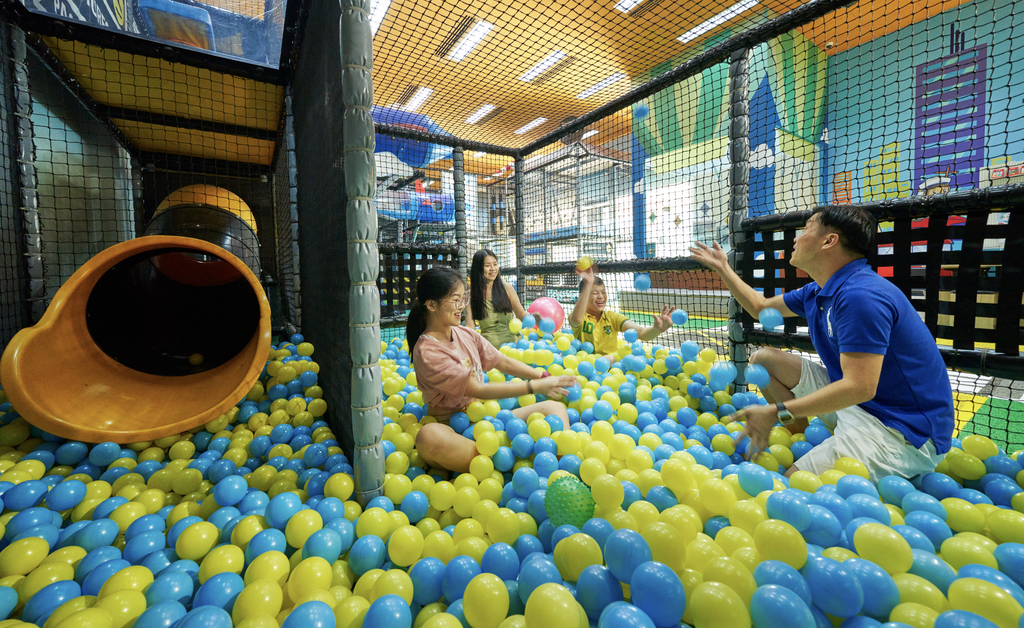
T-Play tends to sit a little outside the usual indoor-playground conversation, but the pricing is worth paying attention to.
At Bukit Batok, current non-member rates are around S$20.37 off-peak and S$25.46 peak, while Khatib is higher at around S$27.25 off-peak and S$32.70 peak. Members pay less. Those prices compare quite favourably with many commercial indoor playgrounds, particularly if you already qualify for HomeTeamNS or T-Play member rates.
The venues are also more substantial than the price might suggest. Bukit Batok has a transport theme, while Khatib uses a Peranakan-inspired concept.
This is one of those cases where membership can genuinely shift the value equation. If you already have access to the lower rate, T-Play becomes one of the more sensible repeat-visit options in Singapore.
KidsSTOP: very hard to beat for local families
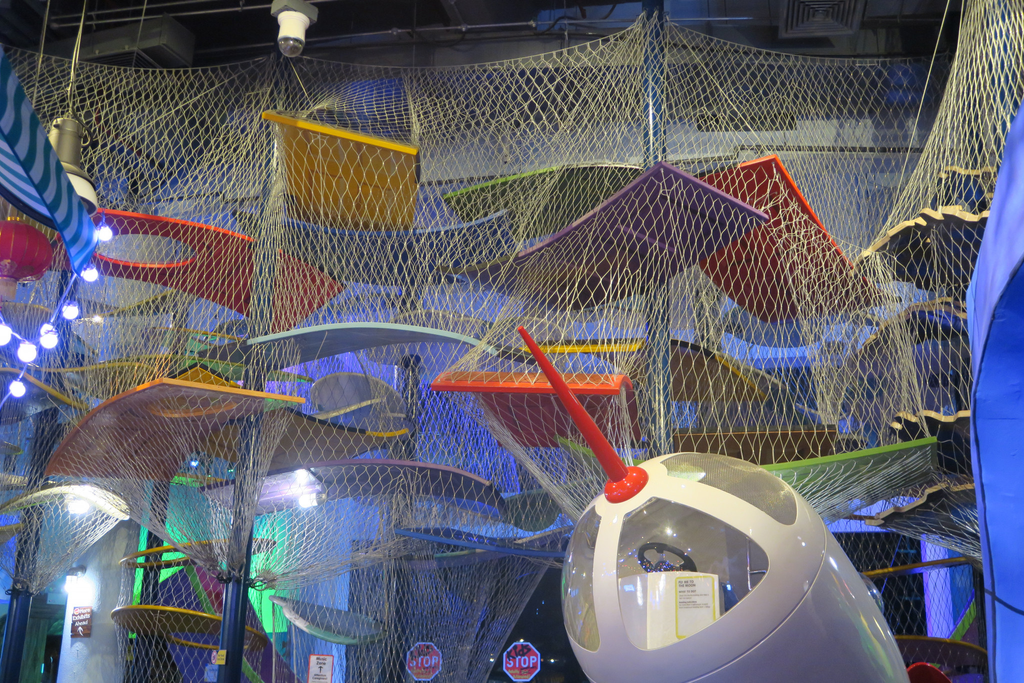
KidsSTOP at Science Centre Singapore is not a traditional indoor playground, but for many families it serves the same purpose: somewhere indoors where children can climb, explore, role-play and stay occupied for a substantial part of the day.
For Singapore Citizens and PRs, the price is unusually low. Current off-peak admission is S$5 for a child and S$2 for an adult. Peak admission is S$10 for a child and S$5 for an adult.
For that price, families get access to a large 3,000-square-metre space with more than 20 exhibits, including the nine-metre Dream Climber, Giant J slide, role-play areas, science exhibits, a dinosaur dig and a Small World area for younger children.
At S$7 off-peak for one child and one adult, there is not much to argue with.
The only real question is whether your child likes this kind of play. KidsSTOP has more exploration and learning built into the experience than a standard soft-play centre. A child who wants endless trampolines may prefer somewhere else. A child who likes role play, science and moving between different activities can easily get far more value here than from a S$35 commercial playground.
VroomTown: judge it as an attraction, not a playground
VroomTown at Marina Square is difficult to compare directly with the rest of this list.
A first-time Learner Pass currently costs S$49 for one hour. That includes one child and one accompanying adult, a short road-safety lesson, use of an electric vehicle, a VroomTown licence card and access to the playground during the session. Returning drivers pay less.
S$49 for one hour would be very poor value if this were simply another soft-play centre, but it is not. Children are paying for a miniature driving experience with proper electric cars, roads and traffic lights. For a child who is deeply interested in vehicles, that is something quite different from climbing through another play structure.
We would think of VroomTown as a themed attraction rather than a playground ticket. If your child simply needs somewhere to burn energy, there are better-value options. If they have been talking about driving, traffic lights and cars for months, the premium is easier to understand.
Is unlimited play actually worth paying for?
Sometimes, but not as often as the pricing makes it seem.
At Giggle Jungle, for example, two hours cost S$35 and unlimited play costs S$45. The extra S$10 looks attractive, but only if your child genuinely wants to stay beyond two hours. Many toddlers are already finished by then. Older children who repeatedly return to climbing walls, high ropes or larger structures are more likely to make proper use of unlimited admission.
The same applies to memberships and multi-visit passes. A pass is only good value if you actually return often enough to reach the break-even point.
It is easy to be persuaded by a low “cost per visit” figure and then realise six months later that you only went twice.
The ticket price is not the whole cost
The final bill is often quite different from the number on the booking page.
Grip socks are an obvious extra. Some venues include one adult but charge for the second. Parking can add several dollars, especially if the playground is inside a central mall. Then there is food. A two-hour session that runs into lunchtime can easily turn into playground admission plus a restaurant meal, and suddenly the outing costs far more than expected.
That does not mean you should avoid paid playgrounds. It just means the more useful comparison is the cost of the whole outing and how much use your child actually gets from it.
So which ones would we actually pay for?
For younger children, Tayo Station is probably the easiest mainstream ticket to justify. It is reasonably priced by current indoor-playground standards and has a road circuit that gives it something genuinely different.
For siblings or older children who need more physical challenge, Giggle Jungle offers a lot for S$35, especially once the high ropes and climbing wall become usable.
DreamDora is a good middle-ground option for children who like pretend play and sensory activities as much as slides.
Kiztopia Marina Square costs more, but we would still pay for it when taking an active child old enough to use the full venue.
Pororo Park is a much more specific recommendation. For a Pororo-loving toddler, yes. For an older child who does not care about the characters, probably not.
And if you are a Singapore Citizen or PR, KidsSTOP remains one of the strongest indoor-play value propositions in Singapore.
Which indoor playground is best value for toddlers?
For most toddlers and younger preschoolers, Tayo Station is one of the safest choices. The scale is manageable, the road circuit gives them something distinctive to do, and the price remains below several of the bigger branded venues.
If your child already loves Pororo, Pororo Park can be worth the extra.
Families who only need 45 minutes to an hour of play should also look at our guide to Free Indoor Playgrounds in Singapore. A free mall play space can sometimes be exactly enough for a toddler.
Which is best for siblings?
Giggle Jungle is particularly useful when siblings are several years apart because the younger-child areas and older-child climbing attractions sit under one roof.
A large Kiztopia outlet can also work well for siblings because there is enough variety for children to split their attention between different zones.
Is a one-hour ticket ever worth buying?
Sometimes, but usually only if your schedule genuinely limits the visit.
At DreamDora, one hour costs S$28 while two hours cost S$36. At Giggle Jungle, one hour is S$30 and two hours S$35.
In both cases, the second hour is cheap relative to the first.
Unless you know your child will be finished quickly, we would usually choose the two-hour option.
Our guide to How Long Should You Plan for an Indoor Playground Visit? goes into this in more detail.
How much should you expect to spend?
For a mainstream commercial indoor playground in Singapore in 2026, around S$28 to S$40 for one child and one accompanying adult for roughly two hours is now fairly typical.
Specialist experiences can cost more, while memberships and weekday rates can bring the price down.
The biggest saving, though, usually comes from choosing the right playground rather than chasing a small discount.
A S$35 playground your child loves for two hours is better value than a S$25 one they want to leave after 40 minutes.
The bottom line
There is no single indoor playground in Singapore that is “worth it” for every family.
For toddlers and preschoolers, we would start with Tayo Station. For siblings and children who want more physical challenge, Giggle Jungle gives you a lot for the money. DreamDora is a good choice for children who move happily between role play and active play, while Kiztopia Marina Square makes more sense once a child is old enough to use most of the venue.
Pororo Park is worth paying for when the Pororo part matters. Without that interest, there are stronger options at a similar price.
VroomTown is expensive as a playground, but easier to justify as a specialist driving experience.
And for local families who enjoy interactive learning as much as soft play, KidsSTOP is still exceptionally hard to beat.
The useful question is not really, “Which one is cheapest?” Rather, it is whether your child is likely to use enough of what you are paying for.